
Solar Quote Comparison Checklist
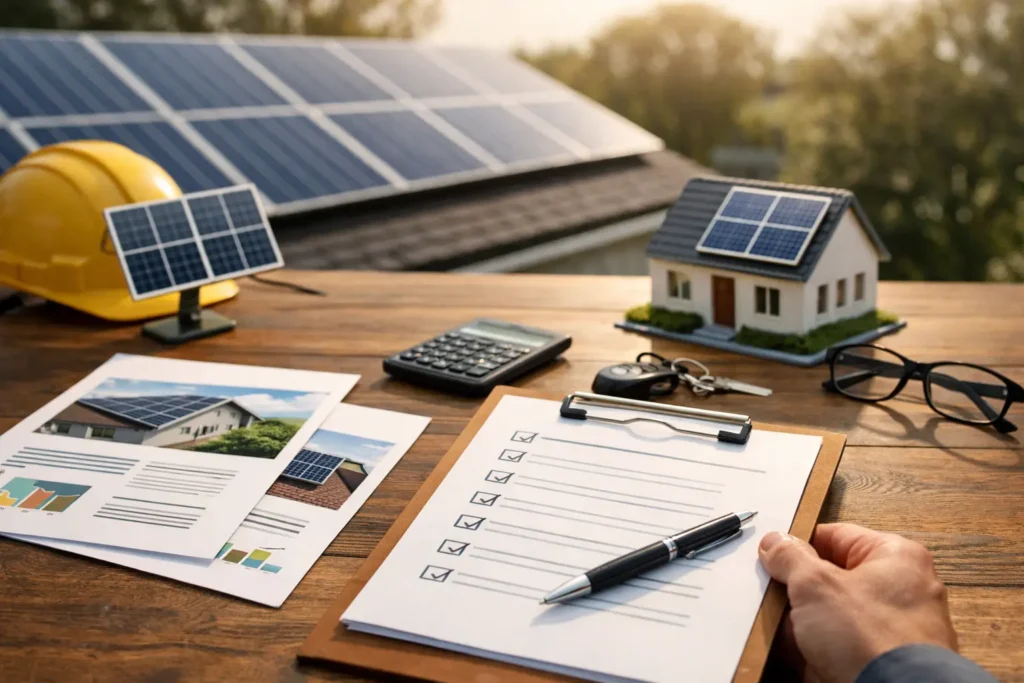
One quote says your roof can take 12 panels. Another says 16. A third promises bigger savings for less money, but the details are thin. That is exactly why a solar quote comparison checklist matters. If you are weighing up proposals for your home or business, the real challenge is not finding a cheaper number. It is working out whether you are comparing like for like.
Solar quotes often look similar at first glance. They all mention panels, inverters, savings and payback. But once you look closer, the differences can be significant. System size, panel quality, inverter type, battery assumptions, scaffolding, warranties and aftercare can all change the real value of what you are being offered. A good comparison process helps you avoid paying less for a weaker system or paying more without getting anything meaningful in return.
What a solar quote comparison checklist should do
A proper solar quote comparison checklist is there to slow the decision down in a good way. It gives you a practical way to test whether each installer has designed a system around your property and your energy use, or simply produced a sales-led estimate.
The key point is simple. A quote is not just a price. It is a technical proposal, a forecast, a workmanship commitment and a service promise. If one of those parts is vague, your risk goes up.
That matters for homeowners trying to cut bills and for businesses looking at long-term return. Solar is not a short-term purchase. You want confidence that the system has been sized properly, installed correctly and backed by a company that will still be there when you need support.
Start with system design, not headline price
The cheapest quote can be the best value, but only sometimes. Start by checking what each installer is actually proposing.
Look at the system size in kWp, the number of panels and the panel wattage. If one quote is for 4.8kWp and another is for 5.7kWp, the higher price may simply reflect a larger system. If the roof layout differs between quotes, ask why. One installer may be avoiding shaded areas while another may be filling every available space without properly accounting for performance losses.
Orientation and shading assumptions matter as well. A quote based on a perfect south-facing roof will overstate savings if your roof faces east-west or has regular shading from trees, chimneys or nearby buildings. You should be able to see how the installer has assessed your site, not just the result they want you to focus on.
Check the generation and savings assumptions
This is where many comparisons go wrong. Two quotes can show very different annual savings, even when the system size is similar.
Ask what electricity price has been used for the calculation. If one installer assumes unusually high future tariffs, the projected savings will look more attractive. Check how much of the solar generation is expected to be used on site and how much is likely to be exported. A household that is empty most of the day will usually self-consume less than a home where someone works remotely. A business that uses most of its power during daylight hours may get stronger value from solar than one operating mainly evenings.
Battery quotes need even closer attention. Savings forecasts can be inflated if the charging and discharging assumptions are unrealistic. A battery can improve self-consumption and resilience, but whether it pays back quickly depends on your usage pattern, tariff and system design. There is no single answer that suits every property.
Compare equipment quality on a like-for-like basis
Panels are not all the same, and neither are inverters or batteries. That does not mean the most expensive brand is automatically the right choice. It means you need to understand what you are getting.
Look at panel efficiency, degradation rate and product warranty. A panel with a slightly better warranty and lower degradation may offer stronger long-term value, especially if roof space is limited. With inverters, check whether the quote includes a string inverter, optimisers or microinverters. Each approach has strengths depending on shading, roof complexity and future expansion plans.
For batteries, look beyond the headline capacity. Usable capacity, warranty cycles, round-trip efficiency and backup capability all affect real-world performance. Some systems are well suited to load shifting and backup, while others are mainly designed to improve self-use of solar. If backup during a power cut matters to you, confirm whether that function is actually included.
Make sure the installation scope is clear
A detailed quote should tell you exactly what is included. If it does not, there is room for confusion later.
Check whether scaffolding, bird protection, isolators, mounting system, monitoring, electrical works and commissioning are listed. If a battery or EV charger is included, the quote should state the model and the installation scope clearly. For commercial projects, check whether grid application support, export limitation and any distribution network requirements are covered.
It is also worth asking who will carry out the work. An in-house installation team often gives better continuity between survey, design and delivery. If parts of the project are subcontracted, that does not always mean a problem, but it does make it more important to understand who is responsible for quality control and aftercare.
Use this solar quote comparison checklist for installer quality
The installer matters as much as the hardware. A good system fitted badly can still become an expensive headache.
Look for evidence of proper accreditation, insurance and compliant installation standards. Ask what workmanship warranty is provided and what support looks like after handover. Will you receive clear documentation, system sign-off and guidance on monitoring performance? If there is a fault six months later, do you know who to call and how quickly they are likely to respond?
It is also sensible to look at how the quote itself has been presented. Was it tailored to your property, or does it feel generic? Were your questions answered directly? Transparency during the sales process is usually a good indicator of what the installation experience will be like.
For customers in Dorset and Hampshire, local knowledge can be useful here. An installer familiar with local properties, network processes and planning considerations will often spot practical issues earlier and communicate them more clearly.
Finance, payback and long-term value
If finance is part of the proposal, compare that separately from the system cost. Monthly payment figures can make a quote feel more affordable, but they do not tell you the full cost over the term.
Ask for the cash price, the financed price and the assumptions behind any payback estimate. A good proposal should be straightforward about what is guaranteed and what is projected. Future bill savings are estimates, not certainties. Energy prices change, usage changes and export arrangements can change too.
That does not make the numbers meaningless. It just means they should be presented honestly. The best quote is usually the one that balances realistic savings, suitable equipment and dependable delivery, rather than the one with the most optimistic spreadsheet.
Questions worth asking before you choose
If you are left with two or three strong options, a few final questions can make the decision easier. Ask why the system was sized the way it was. Ask what would change if you added a battery now or later. Ask what happens if monitoring shows lower-than-expected performance. Ask how warranty claims are handled and whether the installer will remain your main point of contact.
You are not looking for a polished script. You are looking for clear, confident answers. Good installers should be comfortable explaining trade-offs. Sometimes a simpler system is the better fit. Sometimes a higher upfront cost makes sense because the equipment, design or aftercare is materially better. What matters is whether the reasoning stands up.
The warning signs to watch for
Be cautious if a quote is missing product models, estimated generation, warranty details or installation scope. Be equally cautious if the savings look unusually high but the assumptions are not shown. Pressure selling, short-lived discounts and vague promises about returns are all signs to slow down.
A trustworthy solar proposal should make the decision easier, not harder. You should come away understanding what you are buying, what it is expected to do and what support comes with it.
When you compare quotes properly, you stop shopping for the lowest number and start choosing the right system for the property, the budget and the long term. That usually leads to a better result – and fewer surprises once the panels are on the roof.