
What Is Commercial Solar?
A rising electricity bill tends to focus the mind quickly. For many businesses, the question is no longer whether energy costs are a problem, but whether there is a practical way to bring them under control. That is where people start asking, what is commercial solar, and whether it makes sense for their site.
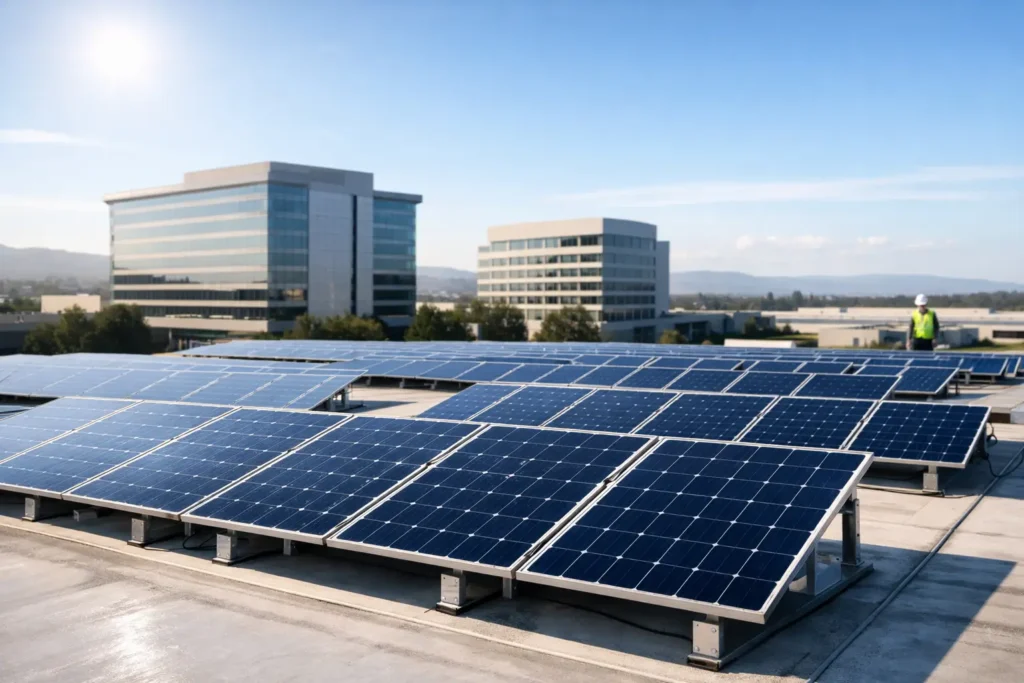
Commercial solar is a solar power system designed for business premises rather than homes. It usually involves solar panels installed on a commercial roof, a ground-mounted area, or a car park structure, with electricity generated on site and used by the business during the working day. In some cases, the system also includes battery storage so excess power can be used later rather than exported straight back to the grid.
That is the simple version. The more useful answer is that commercial solar is an investment in lower operating costs, better energy resilience and more predictable overheads. It is not the right fit for every building, but for the right property and usage pattern, it can make a meaningful difference for years.
What is commercial solar and how does it work?
At its core, commercial solar works in much the same way as domestic solar. Panels convert daylight into electricity, and that electricity is used by the building first. If the business is using power at the same time the panels are generating it, that solar energy reduces the amount of electricity that needs to be imported from the grid.
This matters because many commercial sites use a large proportion of their power during daytime hours, exactly when a solar system is producing most. Offices, warehouses, retail units, schools, farms and industrial sites often have strong daytime demand, which makes solar particularly attractive.
A typical commercial solar setup includes solar panels, mounting equipment, inverters and monitoring. The inverter converts the electricity produced by the panels into a form the building can use. Monitoring software then tracks generation and, depending on the system, can also show import, export and battery performance.
If battery storage is added, surplus generation can be stored and used later in the day. That can be helpful for businesses with a late-afternoon peak, sites that want some resilience during outages, or owners trying to reduce costly imports during higher tariff periods. Whether batteries are worthwhile depends on the load profile, tariff structure and budget.
What makes commercial solar different from domestic solar?
The biggest difference is scale, but that is not the whole story. Commercial systems are usually larger, more bespoke and more closely tied to operational planning. A domestic system may be designed around household demand and roof space. A commercial system has to consider business hours, machinery loads, future expansion, roof condition, compliance and return on investment.
There is also more variation in the buildings themselves. A small office with a simple pitched roof is very different from a warehouse with a large flat roof, or a farm with multiple outbuildings and variable seasonal demand. That is why proper site assessment matters. A generic estimate based only on square footage is rarely enough.
For many businesses, the conversation goes beyond panel count. It includes whether the roof is structurally suitable, whether there is any shading, whether three-phase supply affects design, and how installation can be planned with minimal disruption to operations.
Why businesses install commercial solar
The main reason is usually cost control. Generating electricity on site can reduce reliance on imported power, which helps soften the effect of rising energy prices. For businesses with tight margins, that can be a serious operational benefit rather than a nice extra.
There are wider advantages too. Commercial solar can improve energy independence, support sustainability targets and make a site more future-ready for battery storage or EV charging. For customer-facing businesses, it may also support brand credibility, especially where clients, tenants or procurement teams increasingly ask about environmental performance.
Still, it is worth being realistic. Solar is not a quick fix for every energy problem. It works best when the property, usage pattern and system size are properly matched. Oversizing a system can reduce value if too much electricity is exported at a less attractive rate. Undersizing it may leave savings on the table.
Is commercial solar worth it?
Often, yes, but it depends on how the business uses electricity.
A site with steady daytime consumption is usually well placed to benefit because it can use more of the solar energy directly. A unit that is mostly empty during daylight hours may still benefit, but the economics can look different if a lot of power is exported rather than consumed on site.
Roof condition also matters. If a roof needs major work in the near future, it may make sense to address that first rather than install solar and revisit the roof later. The best outcomes usually come from looking at the building as a long-term asset rather than treating solar as a stand-alone purchase.
The same goes for battery storage. Some businesses assume batteries are essential, while others dismiss them too quickly. In reality, they are useful in the right scenario. If most solar generation is already being used during the day, a battery may add less value. If there is regular evening demand, time-of-use tariffs or a need for greater resilience, the case can become much stronger.
What affects the cost of a commercial solar system?
There is no single standard price because commercial systems vary widely. Cost depends on system size, roof type, access, electrical infrastructure, battery inclusion and any special installation requirements.
A simple warehouse roof with clear access and strong daytime demand is often more straightforward than a complex site with multiple roof elevations, limited access equipment options or dated electrical systems. The amount of design and compliance work involved can also affect pricing.
The important point is not to judge a proposal on headline cost alone. A cheaper quote is not always better value if it leaves out key design work, uses lower-grade components or fails to account for the way your business actually consumes power. Transparent quoting should show expected generation, likely self-consumption, indicative savings and the assumptions behind the numbers.
What to look for before moving ahead
If you are seriously considering commercial solar, the quality of the design and installation process matters as much as the equipment itself. Businesses are right to be cautious here. Poor workmanship, vague projections and outsourced project management can turn a good idea into a frustrating one.
A reliable installer should assess your site properly, review your energy usage and explain the trade-offs clearly. That includes being honest about where solar performs well and where it may be less compelling. If a provider promises the same result for every property, that is usually a warning sign.
You should also expect clarity around warranties, installation timescales, maintenance expectations and aftercare. Commercial solar is a long-term asset, so support after commissioning is not a minor detail. It is part of the value.
For businesses in Dorset and Hampshire, working with a local installer can also have practical benefits. Site visits are easier to arrange, communication tends to be more direct and ongoing support is often more consistent when the team is based within the region.
What is commercial solar best suited to?
Commercial solar suits businesses with usable roof space or land, meaningful daytime electricity demand and a plan to stay in the property long enough to benefit from the return. That includes many offices, industrial units, schools, farms, hospitality venues and mixed-use commercial sites.
It can also be a strong option for property owners and landlords looking to improve the long-term performance of a building. In some cases, solar supports tenant appeal and helps future-proof the site as energy expectations shift.
That said, not every property is ideal. Heavy shading, limited structural capacity or very low daytime usage can reduce the benefit. None of those issues automatically rule a project out, but they do need a proper assessment rather than guesswork.
A good commercial solar system should feel like a practical business decision, not a leap of faith. When the design is tailored to the site, the figures are clearly explained and the installation is handled properly, solar becomes much easier to judge on its real merits.
If you are weighing it up for your own premises, the most useful next step is not chasing the biggest system or the lowest quote. It is getting a clear view of how your building uses energy now, and what a well-designed system could realistically change over the years ahead.