
Best Commercial Solar Panels UK Guide
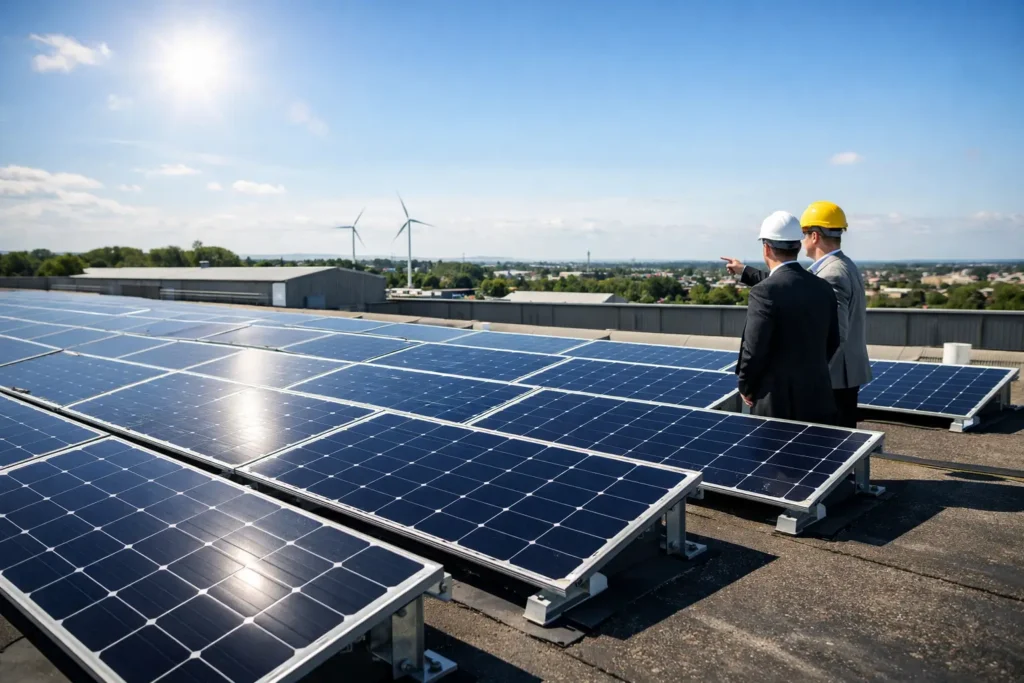
If you are comparing the best commercial solar panels UK suppliers offer, the headline efficiency figure is only part of the story. For a business, the right panel is the one that fits your roof, your load profile, your budget and your payback target without creating headaches later through weak warranties or poor system design.
That is why commercial solar panel selection should never start and end with a product brochure. A warehouse with a large, uncluttered roof has different priorities from a school, office block or farm building. The best result usually comes from matching the panel to the site, then building the wider system around how your business actually uses power.
What makes the best commercial solar panels in the UK?
For most UK businesses, the best commercial solar panels are those that balance four things well – output, reliability, warranty support and value per square metre. High efficiency matters because roof space is often limited, especially on offices and multi-use buildings. But if two panels are close on performance, build quality and long-term support often matter more than a small difference in headline watts.
Temperature performance is another point that gets overlooked. Solar panels do not stop working in warmer conditions, but output can fall as temperatures rise. On large commercial roofs, especially dark roofs in summer, a panel with a better temperature coefficient can hold onto more of its real-world generation.
You should also look at degradation rates. A strong commercial panel should still be producing at a high percentage of its original output decades down the line. Lower degradation means more generation over the life of the system, which improves return on investment rather than simply making the first-year forecast look good.
Panel types and which businesses they suit
Most commercial systems in the UK now use monocrystalline panels. They are generally the strongest choice where you want higher efficiency and cleaner output from a limited footprint. For many SMEs, this is the practical default because it helps maximise savings without needing extra roof space.
Polycrystalline panels were once the budget-friendly alternative, but the gap has narrowed and they are less common in newer commercial installations. They can still appear in older systems or on highly cost-led projects, though they are not usually the first recommendation if roof space is valuable.
You may also come across N-type panels, TOPCon panels and heterojunction technology. These tend to offer higher efficiencies, lower degradation and better performance in some conditions than older P-type designs. For businesses planning to stay in the property long term, paying more upfront for this level of panel can make sense. For others, especially where available roof area is generous, a slightly lower-cost panel may produce a better financial outcome overall.
Efficiency matters, but not in isolation
It is easy to assume the most efficient panel is automatically the best. That is not always true. A premium panel with very high efficiency may be the right call for a constrained roof, but if your site has plenty of usable area, a more moderately priced panel can deliver a stronger payback.
This is where system design becomes more important than brand hype. A well-laid-out array using dependable mid-to-high tier panels will often outperform a poorly planned system built around expensive modules. Shading, roof orientation, cable runs, inverter pairing and export strategy all affect the final result.
For example, a factory with broad south-facing roof space may not need the very highest efficiency module on the market. An office building with plant equipment, rooflights and shaded sections probably benefits more from higher-efficiency panels and tighter design tolerances. The best commercial solar panels UK buyers choose are often the ones that solve a site constraint, not just the ones with the highest advertised number.
The role of warranties and manufacturer backing
Commercial buyers should pay close attention to product warranties and performance warranties. These are related, but not the same. The product warranty covers defects in materials and manufacturing. The performance warranty sets out how much output the panel should retain over time.
A longer warranty is useful, but it is only as valuable as the manufacturer behind it. Established brands with a strong UK and European presence often provide more confidence than unknown names promising impressive figures on paper. If there is ever a claim to make, financial stability and a real support structure matter.
For commercial projects, it is also sensible to ask how the installer handles warranty administration. Businesses usually want one clear point of contact if there is a problem, not a chain of blame between panel maker, inverter supplier and installer. This is one reason many companies prefer a full-service provider with in-house technical oversight.
Are premium brands worth the extra cost?
Sometimes yes, sometimes no. Premium panel brands often offer stronger efficiency, neater aesthetics, lower degradation and longer warranties. If your roof is space-limited or your business wants the best long-term generation profile possible, the additional spend can be justified.
But not every commercial site needs top-tier modules. On agricultural buildings, logistics units or other properties with large roof areas, a reputable mid-market panel may achieve the best balance of cost and output. The return can be better simply because the capital cost is lower while generation remains strong.
What matters is not whether a panel is premium, but whether it is commercially sensible for that building. Good advice should include trade-offs, not push every client towards the most expensive option.
What to ask before choosing a panel
The most useful conversations are usually not about panel brands first. They are about your building, energy usage and investment goals. If you are reviewing proposals, ask what annual generation is expected, what assumptions sit behind that forecast and how much of the power you are likely to use on site.
You should also ask why a specific panel has been recommended for your roof. Is it because of efficiency, weight, warranty, availability, cost per watt or compatibility with the rest of the system? A clear answer tells you a lot about how thoughtfully the design has been put together.
It is also worth asking about fire safety considerations, structural loading, future maintenance access and whether battery storage may be added later. The panel itself matters, but commercial projects work best when the system has been planned with the whole building in mind.
Best commercial solar panels UK buyers should compare carefully
When reviewing the best commercial solar panels UK businesses can install, compare these points as a package rather than in isolation: efficiency, degradation, product warranty, performance warranty, panel dimensions, weight and value. If one panel offers slightly lower efficiency but better warranty terms and a better installed cost, that can be the stronger business decision.
Availability matters too. In a busy market, project delays can affect ROI, operational planning and grant or finance timelines. A panel that looks excellent on paper is less useful if it creates supply issues or pushes the installation back by months.
There is also the question of monitoring and aftercare. A commercial system should not be treated as fit-and-forget. Clear monitoring helps spot underperformance early, and responsive support matters if a fault ever affects output. For many businesses, this practical side of ownership is just as important as the panel specification itself.
Why installation quality matters as much as panel quality
Even the best panel will underperform if the installation is rushed or badly designed. Cable routing, mounting method, inverter selection and commissioning standards all influence safety and output. A cheaper quote can become expensive very quickly if it leads to faults, water ingress, poor generation or a difficult warranty process.
That is why businesses should look beyond the panel brand and examine who is delivering the project. MCS-compliant design and installation, transparent forecasting and a clearly explained process give far more confidence than a glossy product sheet on its own.
For businesses across Dorset and Hampshire, this often comes down to working with an installer that can survey properly, explain the numbers clearly and stay involved after commissioning. New Gen Renewables takes that approach because long-term performance is what makes a commercial system worthwhile, not simply getting panels onto a roof.
The best choice is rarely the panel with the loudest marketing. It is the one that fits your roof, supports your financial goals and comes with the kind of design and aftercare that lets you get on with running your business.