
How Many Solar Panels Needed for Your Home?
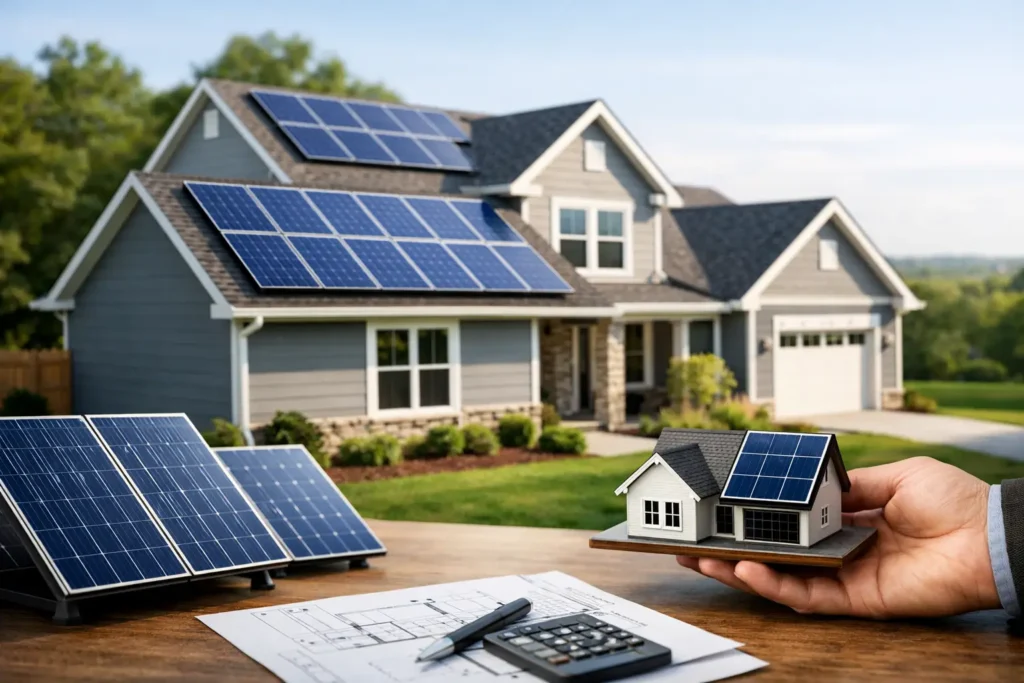
If you have looked at a few solar quotes and found one installer suggesting 8 panels while another recommends 14, you are not alone. Working out how many solar panels needed for a property is not a simple postcode calculation. The right answer depends on how much electricity you use, how your roof performs, and what you want the system to achieve.
For some households, the goal is to trim daytime electricity bills. For others, it is to cover as much annual usage as possible, add battery storage, or future-proof for an EV charger and heat pump. Businesses often have a different priority again – reducing peak daytime import and improving long-term return. That is why a sensible solar design starts with your usage and your building, not a one-size-fits-all package.
How many solar panels needed depends on your usage
The first thing to look at is annual electricity consumption in kilowatt-hours, shown on your bills or smart meter account. A home using 2,000 kWh a year will need a very different system from one using 5,500 kWh. The same applies to commercial premises, where demand can vary widely depending on opening hours, equipment, refrigeration, lighting, and whether the site uses electricity heavily during the day.
As a rough guide, a typical modern solar panel produces around 350W to 450W of peak power. In the South of England, one panel often generates roughly 300 to 420 kWh per year, depending on orientation, pitch, shading, and panel specification. That means a 10-panel system might generate somewhere around 3,000 to 4,200 kWh annually under the right conditions.
This is why there is no universal answer. Two homes with the same floor area can need completely different system sizes if one has an electric vehicle, tumble dryer use every day, and a home office, while the other has modest daytime demand.
What affects how many solar panels are needed?
Electricity use is the starting point, but it is not the whole story. Roof space matters, as does the direction the roof faces. A south-facing roof usually produces the highest output, but east-west layouts can still work very well and often spread generation more evenly across the day.
Roof pitch also affects performance. In the UK, a roof around 30 to 40 degrees is often a strong match for solar generation, though flatter and steeper roofs can still be suitable. Shading is another major factor. Chimneys, neighbouring buildings, trees, and dormers can all reduce output if not properly accounted for in the design.
Panel efficiency matters too. Higher-efficiency panels can generate more power in a smaller area, which is especially useful if roof space is limited. That does not always mean the most expensive panel is the best value, but it does mean panel choice can change the answer to how many solar panels needed on a smaller roof.
Then there is your objective. If you want to offset 50 to 60 per cent of annual electricity use, a smaller system may be perfectly sensible. If you want to maximise generation because you work from home, charge a car during the day, or plan to add battery storage, a larger system may make better financial sense.
A simple way to estimate panel numbers
A practical way to estimate system size is to divide your annual electricity use by expected annual generation per panel.
For example, if your property uses 3,600 kWh per year and each panel is expected to produce about 360 kWh annually, you would need around 10 panels to match that usage over a full year. If your roof is less efficient due to orientation or partial shading, you may need more panels to achieve the same output. If your roof is in a very favourable position and uses high-output panels, you may need fewer.
Here are some broad domestic examples:
- A lower-usage home at 2,000 to 2,500 kWh might suit roughly 5 to 8 panels.
- An average household at 3,000 to 4,000 kWh might suit around 8 to 12 panels.
- A higher-usage home at 5,000 kWh or more might need 12 to 16 panels or beyond.
These are only starting points. They do not account for export levels, battery use, seasonal variation, or future demand.
Roof space often decides the final number
In real projects, the question is often not only how many panels you need, but how many your roof can sensibly take. A standard residential panel is roughly 1.7 to 2 square metres. Allowing for spacing, edges, and obstacles, 10 panels may require around 20 square metres or more of usable roof area.
This is where proper surveying matters. Roof windows, hips, valleys, vents, and access routes can all affect panel layout. Some properties have plenty of total roof area but only a modest section that is actually suitable. Others can fit more panels than expected by using multiple roof aspects.
For homeowners in places such as Bournemouth, Poole and Christchurch, roof orientation varies significantly between newer estates, bungalows, detached homes and coastal properties. A tailored layout usually tells you more than any online calculator.
Homes, batteries and future demand
A common mistake is sizing a solar system only for current usage, without thinking about what is changing next year. If you are planning an electric vehicle, an air source heat pump, or moving from gas cooking to electric, your future electricity demand may rise sharply.
That does not always mean installing the biggest possible system straight away. Budget, roof limitations and payback all matter. But it is worth considering whether a system should be designed to support later additions such as battery storage or extra panels.
Battery storage changes the value of a solar system more than the number of panels it needs. Without a battery, you use solar electricity as it is generated and export the rest. With a battery, you can store surplus generation for evening use, which often improves self-consumption and helps reduce grid import. That can make a slightly larger system more worthwhile for some households.
How many solar panels needed for a business?
Commercial properties are usually sized differently because the pattern of electricity use is different. Many businesses consume a lot of power during daylight hours, which is exactly when solar performs best. That often means a commercial system can make very good use of on-site generation without relying heavily on battery storage.
A small office or workshop might need a modest array, while a farm building, warehouse or multi-unit site may justify a much larger system. In commercial solar, available roof area and daytime load profile are often the key drivers. The best design is rarely about filling every inch of roof. It is about balancing installation cost, grid connection constraints, on-site demand, and expected return.
For business owners, a careful assessment can also look at expansion plans, refrigeration loads, machinery cycles, and whether EV charging is likely to become part of the site’s future demand.
Why online estimates are often wrong
Online calculators can be useful for a first impression, but they often miss the details that make or break performance. They may assume ideal roof orientation, ignore shading, or use average national figures that do not reflect your property. Some also work backwards from a sales target rather than a realistic design brief.
A trustworthy quote should explain why a certain number of panels has been recommended, what annual generation is expected, how much of that power you are likely to use on site, and what the likely savings look like under realistic assumptions. If those figures are vague, it is harder to judge whether the system is properly sized.
This is where an experienced installer earns their keep. Clear proposals, accurate survey work and honest forecasting matter far more than headline panel numbers.
The best system size is not always the biggest
There is a temptation to think more panels always means better value. Sometimes that is true, especially if your roof is strong, your daytime usage is high, and the marginal cost of extra panels is reasonable. But not every property benefits equally from adding more capacity.
Once generation starts to exceed what you can use or store, the financial return of additional panels can soften. Export payments help, but they are usually less valuable than using your own electricity on site. On the other hand, if you expect demand to grow, installing a slightly larger system now can be more cost-effective than trying to expand later.
That is why good solar advice should feel balanced. It should show where the return is strongest, where the limitations are, and what trade-offs come with different system sizes.
If you are asking how many solar panels needed for your property, the honest answer is that it depends – but it should never be guesswork. A well-designed system reflects your roof, your usage, your plans and your budget, so you end up with something that performs well for years rather than a package that simply looked good on paper.