
Average Cost of Commercial Solar Installation
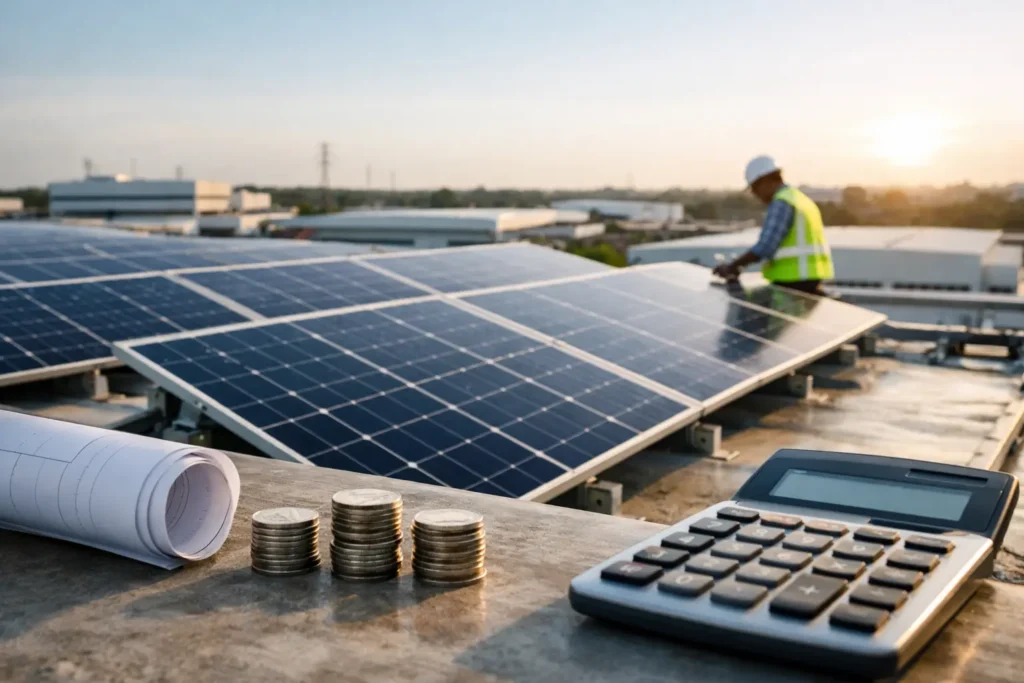
If you have been quoted £40,000 by one installer and £110,000 by another for what sounds like a similar system, you are not alone. The average cost of commercial solar installation can vary far more than most business owners expect, and that is usually because the roof, the site, the electrical setup, and the goals of the project all matter just as much as the panels themselves.
For most UK businesses, commercial solar is not a simple price-per-panel purchase. It is an energy project. The right question is not just what it costs, but what you are getting for that cost, how much electricity it will offset, and how quickly it will pay its way.
What is the average cost of commercial solar installation?
As a broad guide, the average cost of commercial solar installation in the UK often falls somewhere between £800 and £1,300 per kW installed, with larger systems usually coming in at the lower end on a per-kW basis. In real terms, that means a small commercial system of around 30 kW might cost roughly £24,000 to £39,000, while a 100 kW system may sit closer to £80,000 to £120,000.
Once systems move into the several hundred kilowatt range, pricing can become more competitive per unit of capacity, but the overall project cost rises quickly. A 250 kW system could be well into six figures, and a 500 kW installation may run significantly higher depending on access, structural work, grid requirements, and whether battery storage is included.
Those figures are useful as a starting point, but they should never be treated as a firm budgeting rule. Two businesses with similar annual electricity bills can receive very different proposals because the building and the usage profile are different.
Why commercial solar costs vary so much
The biggest reason pricing moves around is system size. Larger systems tend to benefit from economies of scale. The design work, mobilisation, scaffolding, and project management do not rise in a neat straight line, so the cost per kW often drops as the project gets bigger.
Roof type also makes a major difference. A modern metal sheet roof with straightforward access is generally simpler and quicker to work on than a fragile roof, a complex flat roof layout, or a site with restricted access. If extra lifting equipment, traffic management, or out-of-hours working is needed, the project cost can increase.
Then there is the electrical side. Some sites have a clean, modern electrical setup with spare capacity and a sensible connection point. Others need distribution board upgrades, cable runs over long distances, or protection work to make the system compliant and safe. This is one of the most common reasons one quote comes in noticeably above another.
Panel choice matters too, but not always in the way people assume. Premium panels and inverters usually cost more upfront, yet they may offer better long-term performance, stronger warranties, and lower degradation. The cheapest proposal is not always the cheapest system to own over 20 or 25 years.
Average cost of commercial solar installation by system size
For a small office, workshop, retail unit, or farm building, a 20 kW to 30 kW system is often the entry point. These projects commonly range from around £18,000 to £39,000 depending on roof suitability and specification. They are often attractive for businesses with strong daytime demand and a straightforward roof.
A 50 kW system is a common choice for growing firms with a healthy daytime load. A realistic budget might be around £40,000 to £65,000. At this size, the project begins to benefit more from scale, provided the installation is uncomplicated.
A 100 kW system is often where commercial solar becomes a serious strategic asset rather than a modest bill-reduction measure. Costs may range from £80,000 to £120,000 or more. Businesses at this level tend to look more closely at metering, export, and how generation matches working hours.
For 250 kW and above, the pricing becomes more site-specific. Warehouses, manufacturing sites, schools, agricultural operations, and multi-building estates may all suit larger arrays, but the engineering detail starts to shape the budget more heavily. In these projects, roof surveys, structural calculations, and grid considerations are often just as important as the panel count.
What should be included in the price?
A proper commercial solar quote should cover much more than hardware. It should include system design, performance modelling, mounting equipment, inverters, electrical works, installation labour, commissioning, and the documentation required to hand the system over properly.
It should also set out what assumptions have been made. If a quote excludes scaffolding, structural upgrades, grid application work, or access equipment, the headline price may look attractive but the final cost may not. Clear proposals matter because businesses need confidence that the figure on the page reflects the real scope of work.
This is where buyers often get frustrated. Some proposals are little more than a rough estimate based on satellite imagery. Others are built around a real understanding of the site. The difference may not be obvious until the job starts and variations begin to appear.
The factors that affect return on investment
Commercial solar is usually judged on payback, and rightly so, but payback is shaped by more than installation cost. Your daytime electricity use is a major factor. A business that uses most of the power it generates on site will usually see stronger returns than one that exports a large share at a lower value.
Electricity tariff rates matter as well. If your imported power is expensive, each unit of solar electricity used on site is worth more. Businesses with refrigeration, machinery, IT infrastructure, or regular weekday demand often see better value because they can absorb more of their own generation.
Battery storage can improve self-consumption, but it also adds capital cost. For some businesses it is worthwhile, especially where late afternoon and evening use is high or resilience is a priority. For others, adding storage too early can lengthen the payback period. It depends on how the site actually uses energy.
There is also the issue of export. Some sites can secure a worthwhile export arrangement, while others see export as a secondary benefit rather than a key part of the business case. A good proposal should model both on-site use and export rather than relying on generic assumptions.
How to judge whether a quote is good value
A good commercial solar quote is not simply the lowest number. It should show expected generation, likely self-consumption, estimated savings, and the assumptions behind those figures. If those details are vague, it is difficult to compare one proposal with another fairly.
It is also worth looking at installation standards, warranties, and who is actually delivering the work. An in-house team with clear accountability can offer more confidence than a sales-led setup that passes the project through multiple layers. For business owners, that matters. Delays, poor communication, and unclear responsibility can cost more than the initial saving on paper.
Ask practical questions. Has the roof been properly assessed? Is the electrical infrastructure understood? Are there any likely extras not yet included? What monitoring is provided after installation? A reliable installer should be comfortable answering these clearly.
For businesses in Dorset and Hampshire, local site knowledge can help too, particularly on older commercial buildings, agricultural properties, and mixed-use premises where access and electrical layouts are not always straightforward. That local understanding does not replace technical design, but it often improves it.
Is commercial solar still worth it at current prices?
For many businesses, yes. Even with equipment and labour costs shifting over time, commercial solar can still provide a strong long-term return because grid electricity remains expensive and hard to predict. The value is not just in reducing bills now. It is in gaining more control over future energy costs.
That said, not every building is right for it. Some roofs are too shaded, too small, or too close to refurbishment. Some businesses use most of their electricity outside solar generation hours. In those cases, the answer may be a smaller system, a phased approach, or waiting until the site is better suited.
The sensible route is to treat the project as a business investment rather than a generic green upgrade. When the design matches the building and the usage pattern, the numbers are usually much clearer.
At New Gen Renewables, that is exactly how we believe commercial solar should be approached – with honest pricing, realistic performance expectations, and a system designed around the way your business actually operates. If a proposal does not leave you with a clear picture of cost, savings, and scope, it is worth asking more questions before you commit.