
Can Battery Storage Power a House?
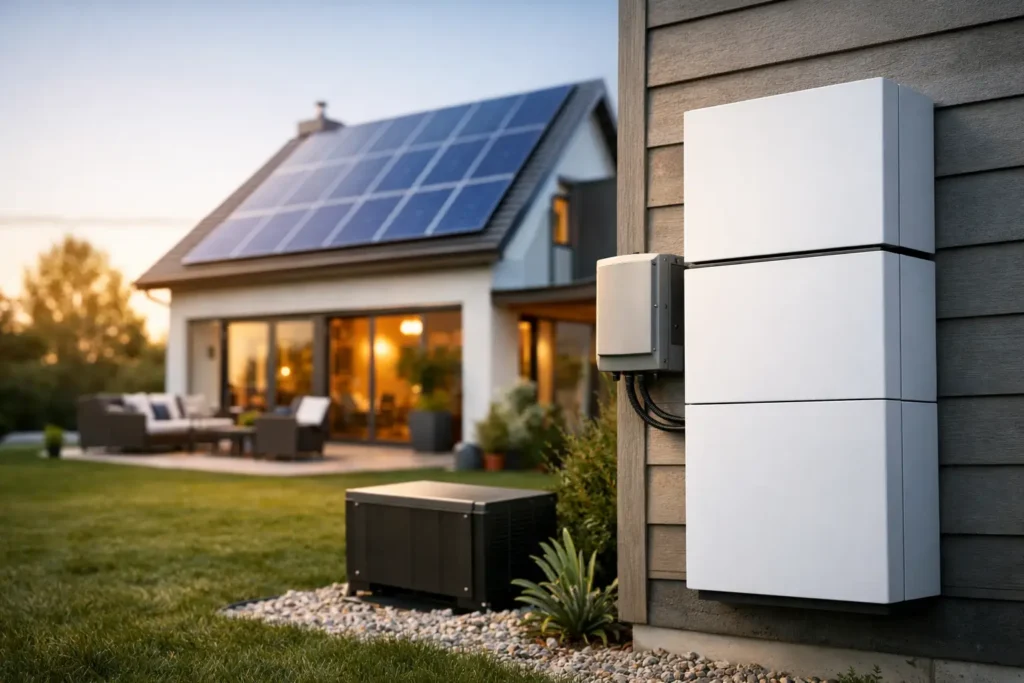
A power cut tends to settle the question quickly. When the lights go out, most homeowners stop asking whether battery systems are clever and start asking something much simpler: can battery storage power a house in a way that is genuinely useful day to day?
The honest answer is yes, but not always in the way people first imagine. A battery can absolutely power a home, yet the size of the house, the way electricity is used, and whether the battery is paired with solar all make a big difference. For some households, battery storage covers the busiest evening hours and gives useful backup. For others, it is part of a wider system designed for much greater independence from the grid.
Can battery storage power a house on its own?
It can, but only if the system is designed for that job.
A home battery stores electricity so you can use it later. That electricity might come from solar panels during the day, from the grid when tariffs are lower, or from a combination of both. When demand rises in the evening, or if there is a grid outage and the system includes backup capability, the battery can supply power to the property.
What matters is capacity and output. Capacity, measured in kilowatt-hours or kWh, tells you how much energy the battery can store. Output, measured in kilowatts or kW, tells you how much power it can deliver at one time. A battery may hold enough energy to run parts of the home for several hours, but still struggle if too many high-demand appliances switch on together.
That is why the question is rarely just can battery storage power a house. A better question is which parts of the house, for how long, and under what conditions.
What a battery can realistically run
In many homes, battery storage works best when it covers the steady, everyday loads. Lighting, broadband, televisions, refrigeration, mobile phone charging and many kitchen appliances can often be supported without difficulty. If the battery is well sized, it may also handle washing machines, dishwashers and similar loads at sensible times.
The challenge usually comes from large electrical demands. Heat pumps, electric showers, ovens, hobs, immersion heaters and EV chargers can draw power quickly. That does not mean they can never run from a battery, but it does mean the system has to be designed around them rather than assuming a standard setup will cope.
For example, a modest battery might comfortably support the essentials through the evening peak, helping a household avoid buying expensive electricity at the worst time. That same battery could be drained much faster if someone starts charging an electric car, uses an electric oven and puts the immersion heater on all at once.
This is where tailored system design matters. Two houses with the same number of bedrooms can have very different electricity patterns. One may use little during the day and peak in the evening. Another may have home working, electric heating and an EV, which changes the picture completely.
How long can battery storage power a house?
There is no single figure, because usage drives everything.
A battery rated at 10 kWh does not mean a home is powered for ten hours. It means there are 10 kWh of stored energy available, less a small amount of system loss. If a household is using 1 kW on average, the battery could in theory last around ten hours. If usage jumps to 3 kW, that stored energy is used much more quickly.
In practical terms, many households use battery storage to cover the evening and overnight period after solar generation drops off. That can be a very effective setup because it matches how many homes actually consume energy. Solar panels generate most strongly in daylight hours, while household demand often rises after work, when lights, cooking and entertainment all come into play.
For backup during a power cut, duration depends on what is placed on the backup circuit. If the system is configured to keep only essential loads running, battery power can stretch much further. If the goal is whole-house backup, the battery capacity usually needs to be larger and the expectations more carefully managed.
Battery storage works best with clear priorities
A lot of disappointment in renewable systems comes from vague promises. Homeowners are sometimes led to believe that adding a battery means complete freedom from the grid. That can happen in some off-grid or heavily engineered systems, but it is not the standard outcome for most properties.
For grid-connected homes, battery storage is usually about three practical benefits. The first is using more of your own solar electricity instead of exporting it and buying power back later. The second is reducing bills by storing cheaper electricity for use when tariffs are higher. The third is improving resilience if the system includes backup functionality.
Those are meaningful benefits, but they are not identical. A battery that is brilliant for bill savings is not automatically ideal for whole-home backup. A battery that supports backup during outages may need extra hardware and a different configuration. If you want both, that should be built into the design from the start.
Solar plus battery versus battery on its own
Battery storage can be installed without solar, and in some cases that makes sense. Households on time-of-use tariffs may charge the battery overnight at a lower rate and use that stored electricity later. Businesses can do something similar to reduce demand at expensive periods.
Even so, battery storage often makes the most financial and practical sense when paired with solar panels. Solar gives the battery low-cost electricity to store during the day, which means more self-consumption and less reliance on imported power. It also improves the overall return on the system because more of the generation is used on site.
Without solar, a battery is mainly shifting grid electricity from one time to another. That can still be worthwhile, but the savings depend much more on tariff structure and household discipline.
What determines whether it is worth it?
The answer comes down to usage, property type and goals.
If your home uses a good amount of electricity in the evening, battery storage can be particularly valuable. If you already have solar and export a fair share of what you generate, a battery may help you keep more of that energy for yourself. If resilience matters because you work from home, rely on refrigeration for medication, or simply want better protection against outages, backup capability may be just as important as bill reduction.
On the other hand, if your electricity use is already low and most of it happens during daylight hours, the financial case may be less dramatic. Equally, if your biggest loads are electric heating and vehicle charging, a small battery may not move the needle much. That does not mean it is the wrong choice, only that sizing and expectations need to be grounded in real consumption data.
A proper assessment should look at half-hourly or hourly usage patterns, not just annual totals. That is how you see whether a battery will genuinely serve the way the property runs.
Can battery storage power a house during a power cut?
Sometimes yes, but not automatically.
This catches people out. Not every battery system provides backup when the grid fails. Some systems shut down for safety unless they are specifically equipped and configured for backup operation. If outage protection matters to you, it should be discussed early, because it affects system design, switchgear and cost.
It also helps to define what you mean by backup. For some households, keeping the fridge, lights, internet and sockets live is enough. For others, the expectation is that the whole property will continue as normal. Those are very different design briefs.
In areas where storm-related outages are a concern, this part of the conversation can be especially relevant. It is one reason many homeowners across Dorset and Hampshire look beyond simple generation figures and ask how their energy system will perform when conditions are less than ideal.
The best approach is a tailored one
Battery storage is not a one-size-fits-all product. The right setup depends on your existing consumption, whether you have solar, whether you want backup power, and how far you want to reduce grid reliance.
A well-designed system should be based on your real usage patterns, not broad assumptions. It should also be explained clearly, with sensible figures for savings, realistic backup expectations and no confusion about what the battery will and will not do. That is where working with an installer that handles design, installation and aftercare in-house can make the decision much simpler.
For many households, the question is not whether a battery can power a house at all. It is whether the system can power the right parts of the house, at the right times, in a way that cuts costs and adds confidence. When that is properly planned, battery storage stops being a gadget and starts becoming a practical part of how a home runs.
If you are considering one, the most useful next step is not guessing at battery size from an advert. It is looking closely at how your property uses electricity now, and deciding what you want your system to do when it matters most.