
Commercial Solar Installation Cost Explained
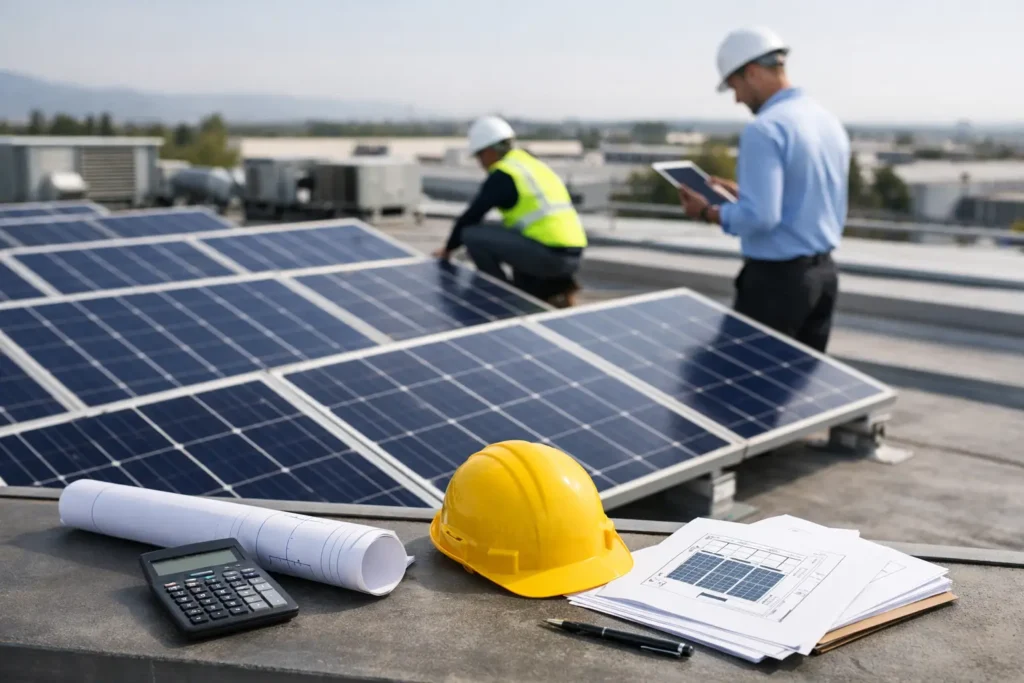
If you have been quoted £20,000 by one installer and £60,000 by another for what sounds like a similar system, you are not looking at a simple pricing gap. You are looking at the real challenge behind commercial solar installation cost – system size, roof condition, grid requirements, access, product quality and long-term performance all change the figure, sometimes dramatically.
For most businesses, the right question is not just, “What does it cost?” It is, “What am I getting for that cost, how much will it save, and how reliable will it be over the next 20 years?” That is where good decision-making starts.
What is a typical commercial solar installation cost?
Commercial solar pricing varies widely because commercial buildings vary widely. A small office, farm building, retail unit and warehouse may all have very different roofs, energy usage patterns and electrical setups.
As a rough guide, a smaller commercial solar system might start from around £15,000 to £25,000. Mid-sized systems often sit somewhere between £30,000 and £100,000, while larger installations for energy-hungry sites can run well beyond that. The per-kilowatt cost usually falls as systems get bigger, but only if the site is straightforward.
That matters because headline price ranges can be misleading. A larger roof does not always mean a better-value project. If the roof needs structural work, access is difficult, or the existing electrical infrastructure needs upgrading, the installation cost can rise quickly.
What affects commercial solar installation cost most?
The biggest factor is usually system size. More panels, more mounting equipment and more inverter capacity mean a higher overall project cost. But size alone does not tell the full story. The design has to match how your business actually uses electricity.
If your site uses most of its power during the day, solar can work very efficiently and deliver stronger savings. If demand is lower during solar generation hours, you may need to think more carefully about export rates, battery storage or whether a smaller system would offer a better return.
Roof type and condition
A modern metal sheet roof on a single-storey commercial unit is often simpler and cheaper to work with than an older roof with multiple levels, fragile surfaces or awkward access. Flat roofs can be excellent for solar, but they may require additional mounting systems and ballast. Pitched roofs can also work well, though orientation and shading matter.
If a roof is nearing the end of its life, installing solar before repair or replacement can be a false economy. Removing and reinstalling panels later adds cost that could have been avoided with better planning.
Electrical infrastructure
Some commercial sites are solar-ready. Others are not. If your existing distribution board, metering arrangement or connection setup needs alteration, this can form a significant part of the quote.
In some projects, grid connection and export limitations shape the design more than the roof space does. A business may have room for a much larger array but be restricted by what the local network can accommodate. That can affect both system size and expected return.
Product choice
Not all panels and inverters are priced the same, and not all offer the same performance, warranty support or long-term reliability. The cheapest system on paper can cost more over time if it generates less, fails earlier or is difficult to support.
For commercial clients, this is especially important. Downtime, poor monitoring and weak aftercare are not small issues when a system is supposed to cut operating costs for years.
Access, scaffolding and installation complexity
Some roofs are quick and safe to access. Others need specialist equipment, traffic management, phased works or strict timing to avoid business disruption. A busy site with loading areas, customer access routes or operational restrictions will often need a more carefully managed installation.
That is not wasted cost. It is part of delivering the work safely and properly.
Why one quote can be much lower than another
This is where many businesses get caught out. A low quote may not include everything needed to complete the project to the right standard. It may exclude monitoring, scaffolding, grid application work, bird protection, electrical upgrades or realistic performance modelling.
Sometimes the design itself is weaker. Panels may be squeezed onto the roof without proper regard for maintenance access, inverter sizing or shading. In other cases, the equipment may be lower grade, or the warranty support may be unclear.
A proper proposal should show not just the price, but what sits behind it. That includes estimated annual generation, likely savings, assumptions about usage, the installation scope, warranties and who is actually responsible for the work. Businesses do not need the cheapest quote. They need the clearest one.
How to judge value, not just price
A commercial solar system is not bought in the same way as office furniture or a basic maintenance contract. It is an infrastructure investment. That means value should be judged over its working life, not just by the upfront figure.
If one system costs more but produces materially better returns because of stronger design, better panel layout or more suitable equipment, that higher quote may be the better business decision. The same applies if it comes with clearer aftercare and less risk.
A sensible comparison looks at payback period, projected annual savings, warranty length, monitoring capability and the quality of the installation process. It should also consider whether the system has been designed around your actual consumption profile rather than a generic target capacity.
How long does payback usually take?
There is no universal answer, but many commercial systems achieve payback in around 4 to 8 years, depending on electricity prices, system cost, self-consumption and any finance arrangement. Businesses with strong daytime demand often see the best results because they use more of the solar power on site rather than exporting it.
Payback can be faster where electricity rates are high and the site has a good roof with minimal complications. It can be slower where usage patterns are less favourable or the installation includes additional works that increase capital cost.
That does not mean a slower-payback project is poor value. Some businesses are motivated just as much by energy resilience, carbon reduction, predictable operating costs and futureproofing against volatile power prices.
Should you add battery storage?
Battery storage increases the upfront cost, so it should never be added by default. For some sites, especially those with strong daytime usage, solar alone may already deliver excellent returns.
For others, battery storage can improve system value by increasing self-consumption, reducing peak import costs or offering greater resilience. Whether that makes financial sense depends on your load profile, tariff structure and operational priorities.
The key point is that battery storage should be modelled properly rather than treated as an automatic upgrade. A tailored recommendation is worth far more than a standard package.
What should be included in a commercial solar quote?
A trustworthy quote should explain the system size, expected annual generation, projected savings, equipment specification, installation method, warranties, monitoring and any assumptions that affect the figures. It should also be clear about whether there are likely extra costs tied to electrical upgrades, roof works or network requirements.
This is one area where an experienced in-house installer makes a real difference. When the design, pricing and delivery process are properly joined up, there is less room for confusion later. That clarity matters more than slick sales language.
For businesses across Dorset and Hampshire, it is also worth working with a company that understands the practical realities of local commercial stock – from industrial units and retail premises to agricultural buildings and mixed-use sites. Every one of those comes with different constraints.
The cheapest route is rarely the safest route
Commercial buyers are rightly cautious. They have seen projects where the numbers looked attractive at quote stage and far less convincing once exclusions, delays or underperformance appeared.
A good commercial solar project should feel clear from the start. You should know what is being installed, why it has been designed that way, what return is realistic and who will support the system after commissioning. That is the standard New Gen Renewables believes commercial clients should expect.
When you are weighing up commercial solar installation cost, the real aim is not to chase the lowest number. It is to invest in a system that works hard, performs reliably and still looks like a sound business decision years after the scaffolding comes down.