On Grid Versus Off Grid: Which Fits Best?
A lot of solar enquiries start with the same assumption: off-grid must mean more freedom, so it must be better. In practice, the choice between on grid versus off grid comes down to something more grounded – how you use energy, how much resilience you need, and what level of investment makes sense for your property.
For some households and businesses, staying connected to the grid while generating and storing their own power is the most practical route. For others, especially remote sites or buildings where a grid connection is poor, expensive or unavailable, an off-grid system can be the right answer. The key is not choosing the more dramatic option. It is choosing the one that fits your real energy demand.
What on grid versus off grid actually means
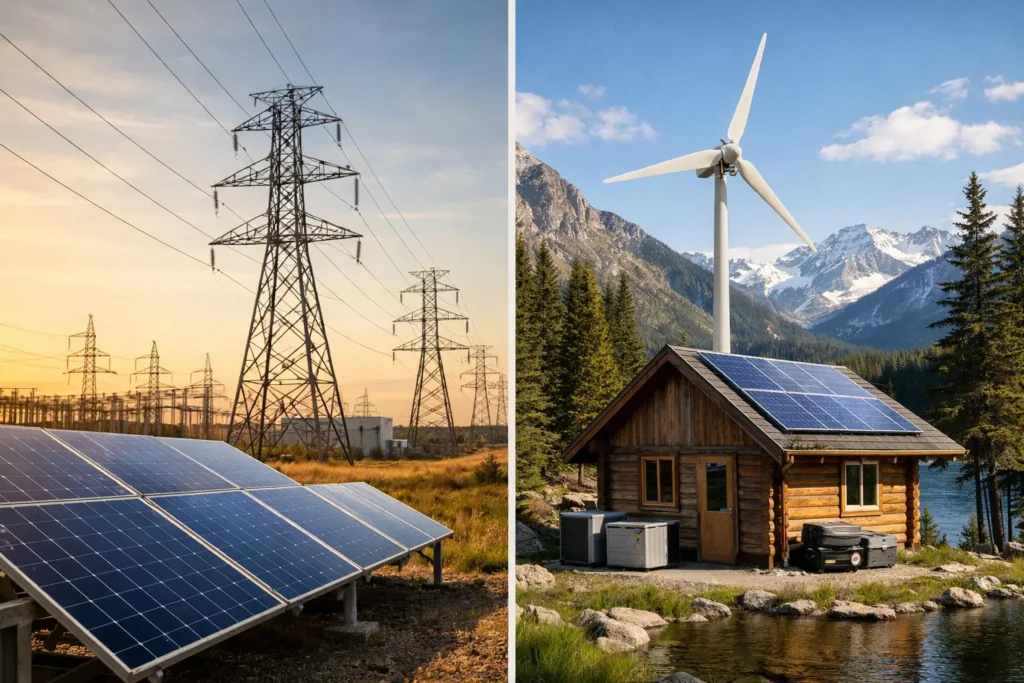
An on-grid system is connected to the public electricity network. Your solar panels generate power for use on site, and if you produce more than you need at that moment, the surplus can usually be exported. When solar production is low, such as overnight or during winter peaks, you import electricity from the grid as normal.
An off-grid system works independently of the public network. It relies on solar generation, battery storage and, in many cases, some form of backup generation to keep the property supplied. There is no grid safety net, so the system has to be sized far more carefully around daily use, seasonal changes and peak demand.
That difference sounds simple, but it changes almost every part of the design. On-grid systems are generally about reducing bills and improving self-sufficiency. Off-grid systems are about full energy independence, which is a bigger technical and financial commitment.
Why most properties suit on-grid solar
For the majority of UK homes and commercial sites, on-grid solar makes the most sense. The reason is straightforward: it gives you the benefits of solar generation without asking your system to carry every hour of demand, every day of the year.
If your property is already connected to the mains, an on-grid setup is usually the more cost-effective option. You can still cut imported electricity, add battery storage to use more of your own generation, and improve resilience without oversizing the whole system to cover the darkest winter weeks.
This matters because UK solar output is seasonal. A system that performs strongly from spring through early autumn will produce far less in December and January. On-grid homes and businesses can work with that variation because the grid fills the gaps. Off-grid properties have to engineer around it.
For many customers, that is the turning point. They may want lower bills, more control over energy use and protection from rising electricity prices, but they do not necessarily need complete separation from the grid.
Where batteries fit into on-grid systems
Battery storage often narrows the gap between standard grid-connected solar and the idea of energy independence. With a battery, you can store excess daytime generation and use it later in the evening when demand is still high but the panels are no longer producing.
That improves self-consumption and can make an on-grid system feel much more capable. It is particularly useful for households with evening usage, people charging EVs at home, or businesses with demand outside peak solar hours.
Still, a battery does not automatically turn an on-grid system into an off-grid one. It gives flexibility and backup potential, but the property remains connected to the wider network and can still draw power when required.
When off-grid is the better option
Off-grid solar tends to make sense when a grid connection is not practical, not reliable, or not economical. That could apply to remote homes, rural outbuildings, agricultural sites, holiday lets, workshops or commercial locations where bringing in a new connection would be extremely costly.
In those cases, off-grid is not a lifestyle statement. It is often the most sensible infrastructure choice available.
A well-designed off-grid system can provide dependable power, but it needs proper planning. The installer must look closely at appliance loads, heating methods, occupancy patterns, winter demand and battery autonomy. A property with electric heating, hot water and cooking will need a far larger system than one using solar for lighting, refrigeration, communications and general plug loads only.
That is why honest advice matters here. Off-grid is very achievable, but only if the numbers work. Undersized systems lead to frustration, battery stress and ongoing power limitations. Oversized systems can mean spending far more than necessary.
The biggest trade-off: cost versus independence
If you strip the decision back, on grid versus off grid is often a question of trade-offs.
On-grid systems are usually cheaper to install because the grid acts as support. You do not need enough battery capacity to cover long periods of poor generation, and system sizing can stay focused on reducing imported electricity rather than replacing it completely.
Off-grid systems usually cost more because they need more storage, more careful load management and often some form of backup. The design threshold is higher because reliability matters more. If the battery is depleted and generation is weak, there is no normal fallback.
That does not mean off-grid is poor value. In the right setting, especially where a new mains connection would be expensive, it can be the smarter financial decision. But it should be assessed against the full picture, not just the appeal of being self-contained.
Reliability is not just about having power
A common misunderstanding is that off-grid always means better resilience. In reality, resilience depends on design quality, battery capacity, backup arrangements and realistic energy expectations.
An on-grid solar and battery system can offer excellent day-to-day reliability and may provide backup for essential circuits, depending on the equipment and configuration used. For many homes and businesses, that level of resilience is enough. It covers the practical concern without requiring a full off-grid redesign.
An off-grid system can also be highly reliable, but only when demand is properly controlled. That may mean being more aware of when heavy loads are used, especially in winter. For some property owners, that is no issue. For others, particularly busy households or energy-intensive businesses, it can become restrictive.
So the better question is not which is more resilient in theory. It is which system can provide reliable power for your actual pattern of use.
How to choose between on grid versus off grid
The right answer usually becomes clearer once a few practical questions are dealt with.
First, is the property already connected to the grid, and if so, is that connection dependable? If the answer is yes, an on-grid system with or without battery storage is often the strongest place to start.
Second, what are you trying to achieve? If your main aim is to reduce bills, improve return on investment and gain more control over energy use, grid-connected solar is usually the better fit. If your main aim is complete energy autonomy because the site is remote or connection costs are unreasonable, off-grid deserves serious consideration.
Third, how flexible is your energy use? Off-grid properties benefit from active load management. If the site has stable, predictable demand and occupants are comfortable working within system limits, off-grid becomes more practical.
Fourth, what does winter look like? This is where realistic design matters most in the UK. Summer performance can make almost any system look generous. Winter is what proves whether the system is properly matched to the property.
Why bespoke design matters more than labels
The phrase on grid versus off grid makes it sound like a simple either-or decision, but many projects sit somewhere in between. A grid-connected property may want battery storage and backup capability for greater resilience. A remote building may need a hybrid arrangement built around solar, batteries and generator support.
That is why good system design matters more than broad labels. The right installer should ask how the building is used, when demand peaks, what future changes are planned and where budget needs to be protected. They should also be clear about what a system will and will not do.
For homeowners and businesses across Dorset and Hampshire, that clarity is often what separates a solid long-term investment from an expensive disappointment. At New Gen Renewables, we see the best outcomes when customers are given a straightforward view of the trade-offs at the start, not sales talk dressed up as certainty.
If you are weighing up on-grid and off-grid solar, the smart move is to start with your property, your usage and your priorities. Independence sounds appealing, but the best system is the one that works reliably for years, fits your budget and leaves you confident in the decision.